
Save £40 on all new patient consultations

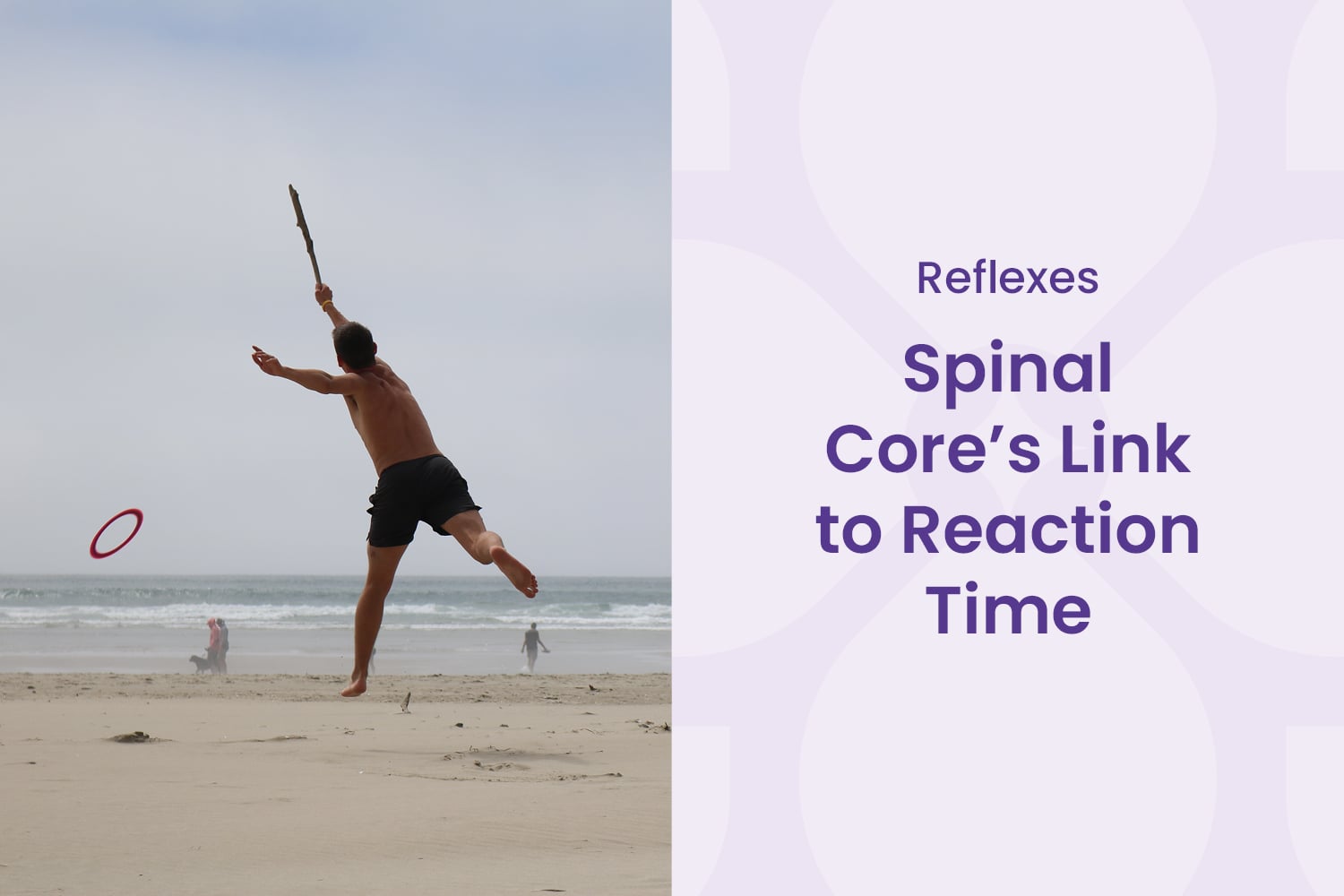
Something falls off the worktop, and you catch it before you’ve registered what it was. Nobody thinks of that as fitness, but it’s one of the more revealing things your body does.
Catching it isn’t a strength problem. It’s a speed‑of‑processing problem, and chiropractic care is interested in that side of movement rather than the muscular side.
Your brain had to receive information, work out where your hand was, and issue instructions, all inside a fraction of a second. Nothing about that sequence is optional, and every part of it depends on how good the incoming information was.
Most of that information travels through your spine. The spinal cord carries traffic in both directions, and the column around it is generating a stream of its own about position, load and movement.
The small muscles between your vertebrae are a big part of that. They’re densely supplied with the sensors that report where each segment sits and how fast it’s moving, and they report by being stretched.
When a segment stops moving through its normal range, those muscles stretch less, and what they send back loses detail. Your brain fills the gap with an estimate, and estimates are slower to act on than facts.
None of this shows up as feeling slow. Nobody notices a reaction taking marginally longer than it might have.
It shows up in the near misses. The step off a kerb that didn’t quite land right. The stumble on the stairs you recovered from without falling. The catch you didn’t quite make.
These are also the events nobody counts. You don’t log a near miss the way you’d log a fall, so a gradual change in timing has nothing obvious to show up in.
Most people file those moments under clumsiness or tiredness. Some of the time, they’re a timing issue in a system working from information that isn’t as sharp as it could be.
Timing is one of the reasons chiropractors care so much about how individual segments move. A joint moving well contributes detailed, up‑to‑date information. A restricted one contributes less, and the estimate filling that gap takes longer to act on.
Restoring movement to those segments is intended to change the quality of what they contribute. It isn’t training, and it isn’t practice. It’s maintenance on the reporting system that sits underneath both.
Individual responses vary considerably. What one person notices may be quite different from the next, and the same restriction affects two people differently depending on what else they bring with them.
Precision matters far more in everyday life than most people credit. Not on a pitch or in a gym, but on wet steps, uneven pavements, and the moment you turn quickly because someone said your name.
Those situations are decided in milliseconds by systems you never consciously engage. They work from whatever information they’re given.
Keep that information clear and your body has a better chance of getting there first. That’s not about being athletic. It’s about your reactions arriving when you need them rather than just after.